
 If you own cryptocurrency, you may have estate planning concerns. Since it does not follow the same rules as traditional property, the way it is accessed, stored, and transferred creates planning issues that a standard estate plan does not automatically address.
The good news is that with the proper inheritance planning for cryptocurrency, you can go forward with peace of mind.
Why Cryptocurrency Requires a Different Way of Thinking
Most estate planning focuses on ownership. Who owns the asset, and who should receive it after death? With cryptocurrency, ownership is only half the story. Access is the other half, and in many ways, it is the more important one.
Traditional assets come with built-in systems for transfer. Banks recognize court orders. Brokerage firms respond to executors. Real estate records change hands through established processes.
Cryptocurrency does not rely on any of those systems. If the information needed to access it disappears, the asset itself is effectively lost.
That reality shifts the planning conversation. The question is not just who should inherit your crypto, but whether anyone will be able to reach it at all.
What Counts as Cryptocurrency for Estate Planning Purposes
From an estate planning perspective, cryptocurrency includes more than a balance on an exchange.
Some people hold digital assets through platforms like Coinbase or Kraken. Others store them in private software wallets or on physical devices known as cold storage wallets. In some cases, holdings are spread across multiple methods.
Each setup comes with different risks and responsibilities. Exchange accounts may be governed by platform rules. Self-custodied wallets place all responsibility on the owner. Cold storage adds security, but also adds another layer of complexity.
Before any legal planning happens, it helps to understand how and where your digital assets are actually held.
Why a Will Alone Is Not Enough
A will can say that your cryptocurrency goes to a particular person. Unfortunately, that instruction does not give anyone the ability to access it.
Executors do not receive special powers over private keys. Courts cannot recreate passwords. No one can override the underlying technology.
This is where many well-intentioned plans fall apart. The paperwork looks complete, but the practical ability to transfer the asset is missing. Without access information, even the most carefully drafted will cannot accomplish much.
Access Is the Real Issue With Cryptocurrency
Every cryptocurrency wallet is controlled by access credentials, often referred to as private keys or recovery phrases.
Think of these as the master keys to the asset. Lose them, and the cryptocurrency is gone permanently. Share them too freely, and you invite security risks during your lifetime.
Good planning finds a middle ground. Access information needs to exist in a form that can be used when necessary, without being exposed prematurely. That balance requires more thought than most people expect, but it is manageable with the right structure.
The Risk of Informal Planning
Some people write passwords on paper. Others keep everything in their head. A few assume that family members will sort things out later. Those approaches feel simple, but they rely heavily on everything going right.
Life rarely cooperates that way. Illness, incapacity, or sudden death can turn informal systems into permanent obstacles. Security shortcuts can also lead to loss long before inheritance ever becomes relevant. Digital assets reward discipline, not improvisation.
How a Revocable Living Trust Can Help
A revocable living trust is often a useful tool for holding or controlling cryptocurrency. When structured properly, the trust establishes legal authority for a successor trustee to manage assets if you can no longer do so.
That authority matters, especially when dealing with exchanges or custodial platforms that require documentation before allowing access. A trust also provides continuity. Management does not stop simply because you are no longer able to act personally.
It is important to understand what a trust does and does not do. The trust creates legal authority, but it does not magically provide passwords or recovery phrases. Those details still need to be handled separately.
Choosing the Right Administrator
Not every trustee is well suited to managing cryptocurrency. Technical expertise does not require a computer science degree, but basic familiarity matters. Understanding wallets, exchanges, and security practices makes administration far smoother.
In some families, an individual with the right background fits well. In others, a professional trustee may be more appropriate. The decision depends on the complexity of the assets and the comfort level of the people involved.
Providing Instructions Securely
One common mistake is placing sensitive access information directly inside estate planning documents. That creates obvious risks, especially when documents are shared or stored electronically.
A better approach separates authority from access details. Legal documents establish who has the right to act. Instructions about how to access digital assets are stored securely elsewhere, often in a way that can be updated without changing the estate plan itself.
This separation allows the plan to stay current even as technology evolves.
Planning for Incapacity
Incapacity often causes more immediate problems than death. If you cannot manage your affairs, digital assets can become frozen at exactly the wrong time. Bills still need to be paid. Investment decisions still matter.
A trust-based structure, combined with clear access instructions, allows someone to step in without delay. That continuity reduces stress and avoids unnecessary losses during already difficult periods.
Tax Considerations Unique to Cryptocurrency
Many people worry about capital gains taxes when passing cryptocurrency to heirs. In most cases, that concern is overstated. Like stocks and real estate, cryptocurrency generally receives a step-up in basis at death.
That means unrealized gains during life are usually eliminated. The beneficiary starts with a tax basis equal to the asset’s fair market value at death. Capital gains tax applies only if the cryptocurrency is later sold for more than that value.
Even so, tax planning is not irrelevant. Valuation can be tricky because prices vary across exchanges and time zones. Good records matter.
It is also important to remember that income tax and estate tax are separate systems. While the step-up addresses income tax, high-value cryptocurrency still counts toward the taxable estate when estate taxes apply.
RUFADAA Rules
Any discussion of cryptocurrency inheritance should include the Revised Uniform Fiduciary Access to Digital Assets Act, commonly called RUFADAA. This law governs when and how fiduciaries can access digital assets.
RUFADAA does not grant automatic access. Instead, it creates a hierarchy. Online tools provided by platforms may control access first. Legal documents come next. Platform terms of service still play a role.
Without clear authorization, executors or trustees may be blocked from accessing accounts, even when their legal authority is otherwise valid. Coordinated planning allows RUFADAA to support fiduciary access without compromising privacy or security.
Coordinating Your Overall Estate Plan
Cryptocurrency should not sit on an island by itself. It interacts with other assets, other beneficiaries, and broader inheritance goals. Some heirs may want digital assets. Others may prefer more traditional property.
Volatility also matters. Crypto values change quickly, which can affect fairness if planning is not coordinated. A thoughtful approach integrates digital assets into the overall plan rather than treating them as an afterthought.
Common Mistakes to Avoid
Many problems arise from treating cryptocurrency as either a novelty or a bank account. Both views miss the point. Digital assets require intentional planning that respects both legal and technical realities.
Failing to document access methods, relying on platforms to solve succession issues, or postponing planning until later all increase the likelihood of loss. These mistakes are common, but they are avoidable.
Why Timing Matters
Technology changes quickly. Platforms evolve. Security practices improve. Instructions that worked a few years ago may no longer be appropriate today.
Regular review keeps the plan functional. Updating access instructions and confirming that fiduciary authority still aligns with current holdings protects the value you have built.
Professional Estate Planning Guidance
Cryptocurrency planning lives at the intersection of law, technology, and tax. Coordination matters. Documents must align with platform policies, state law, and practical security concerns.
Professional guidance brings those elements together into a workable strategy. The goal is clarity, not complexity.
Bringing It All Together
Cryptocurrency represents real value. Without planning, that value can disappear permanently. Inheritance planning for digital assets focuses on access, authority, and coordination.
With the right structure in place, cryptocurrency can pass just like any other asset, without unnecessary confusion or loss. Thoughtful planning turns a technical challenge into a manageable part of a well-rounded estate plan.
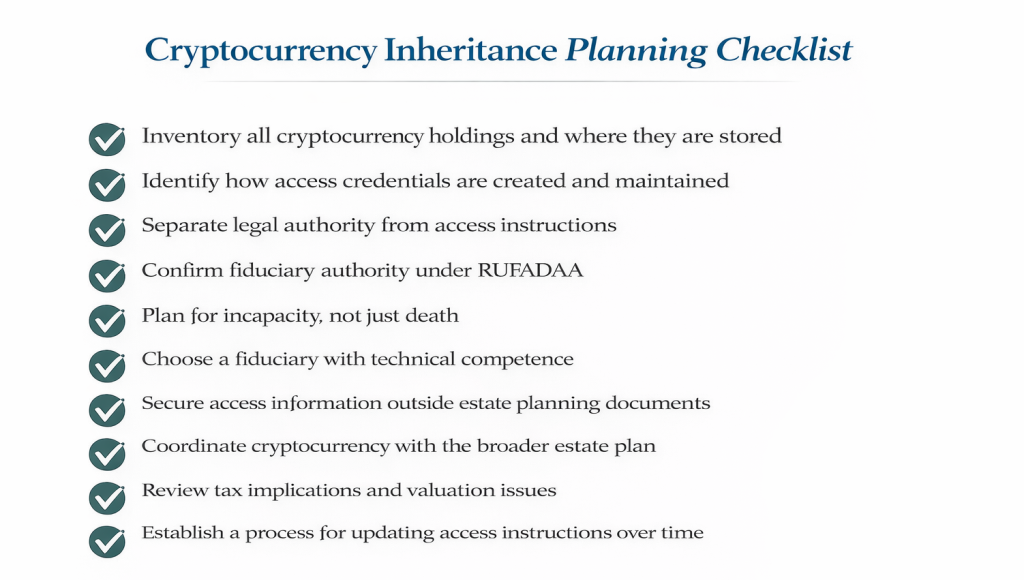
Cryptocurrency and Digital Estate Planning FAQs
Do I need special estate planning documents just because I own cryptocurrency?
Not necessarily special documents, but you do need intentional planning. Standard wills and trusts can work, but only if they are coordinated with clear instructions about access. Without that coordination, even well-drafted documents may fall short.
Can my executor or trustee access my cryptocurrency after I die?
Only if you give them both legal authority and a practical way to access it. Legal authority comes from your estate planning documents. Access depends on whether someone can locate and use the information needed to reach your wallets or accounts. One without the other is not enough.
Should I put my passwords or private keys in my will or trust?
No. Estate planning documents are not the right place for sensitive access information. Those documents may be shared, stored digitally, or updated infrequently.
A safer approach separates legal authority from access instructions and stores access details securely outside the documents themselves.
Does cryptocurrency pass through probate?
That depends on how it is owned and titled. Assets held in a revocable living trust typically avoid probate, including cryptocurrency, as long as the trust is properly structured. Assets held in your individual name may still require probate, even if they are digital.
What happens if I become incapacitated but still own cryptocurrency?
Without planning, your digital assets can become inaccessible at exactly the wrong time. A trust-based plan can allow someone to step in and manage those assets if you are unable to do so, provided access information is available.
Is cryptocurrency taxed differently when someone inherits it?
In most cases, cryptocurrency receives a step-up in basis at death, similar to stocks or real estate. That generally eliminates capital gains that accrued during your lifetime. However, good records are still important, and estate taxes are a separate issue for larger estates.
Does RUFADAA give my family automatic access to my crypto accounts?
No. RUFADAA sets rules for access, but it does not grant it automatically. Platforms may rely on their own tools or terms of service unless your estate planning documents clearly authorize fiduciary access. Planning must be deliberate to work within those rules.
Can I rely on the exchange to handle inheritance issues?
You should not assume that an exchange will solve succession issues for you. Platform policies vary, change over time, and often require specific documentation. Planning outside the platform provides more control and flexibility.
How often should I review my crypto estate planning?
Any time your holdings change significantly, or when you change how assets are stored. Technology evolves quickly, and instructions that made sense a few years ago may no longer be appropriate.
Is cryptocurrency estate planning only for large holdings?
No. Even modest amounts can be lost permanently without access planning. The dollar value does not matter nearly as much as the technical reality of how digital assets work.
We Are Here to Help!
Effective planning involves the agility to address different circumstances. For some, cryptocurrency is a major part of the equation, and it is irrelevant for others. When you work with us, we will learn about your situation and make tailored recommendations.
With the right understanding under your belt, you can make informed decisions, and your plan will be customized to suit your specific needs. As time goes on, if revisions are necessary, we will be just a phone call away.
To set the wheels in motion, send us a message or call our Fort Worth, TX estate planning office at 817-899-3286.

- Lessons Learned From These Celebrity Estate Planning Mistakes - September 30, 2026
- Your Long-Term Care Solution: Medicaid Crisis Planning - September 23, 2026
- Choosing the Right Executor or Trustee: Key Considerations - September 16, 2026